Capturing Curiosity at the Bad Bunny Superbowl


2026-01-06
When we launched Audiences for Climate Communications in 2023, we started with a few key questions: who were climate communications reaching, whom might they be leaving out, and how could more climate content be integrated into media, beyond the political echo chamber?
What we found then was that climate messaging had a distribution problem—it was only reaching existing supporters, primarily because it was delivered mostly via news and politics, which many audiences outside a progressive base just weren’t consuming. Through a set of rich climate audience tools we invited climate communicators to ditch the traditional message first approach and think organically and authentically with a culture-first approach.
Fast forward to now: we still see plenty of climate stories in the news, like the rollbacks of climate friendly policies, attacks on climate science, a return to fossil fuels, the rush to secure critical minerals as the new geopolitical arms race. Which made us wonder: were there any stories reaching audiences outside politics and news?
To understand what was happening outside of politics and news, and what might have changed since our original analysis, we sampled YouTube videos consumed by over 300K+ media panelists in the U.S. between June, 2024 and March, 2025. We focused on YouTube because it is a major hub for cultural content—84% of adults in the U.S. report using the platform—and it contains some of everything, including politics.
The chart below shows mention of “climate” and “global warming” as a percent of the videos viewed—including everything from music to news to podcasts to children’s programming—on YouTube by week for the study period. The upshot? Climate as a topic is rare as a random sample of the culture, except when the cultural moment is about politics (the big spike below is the November 2024 election).
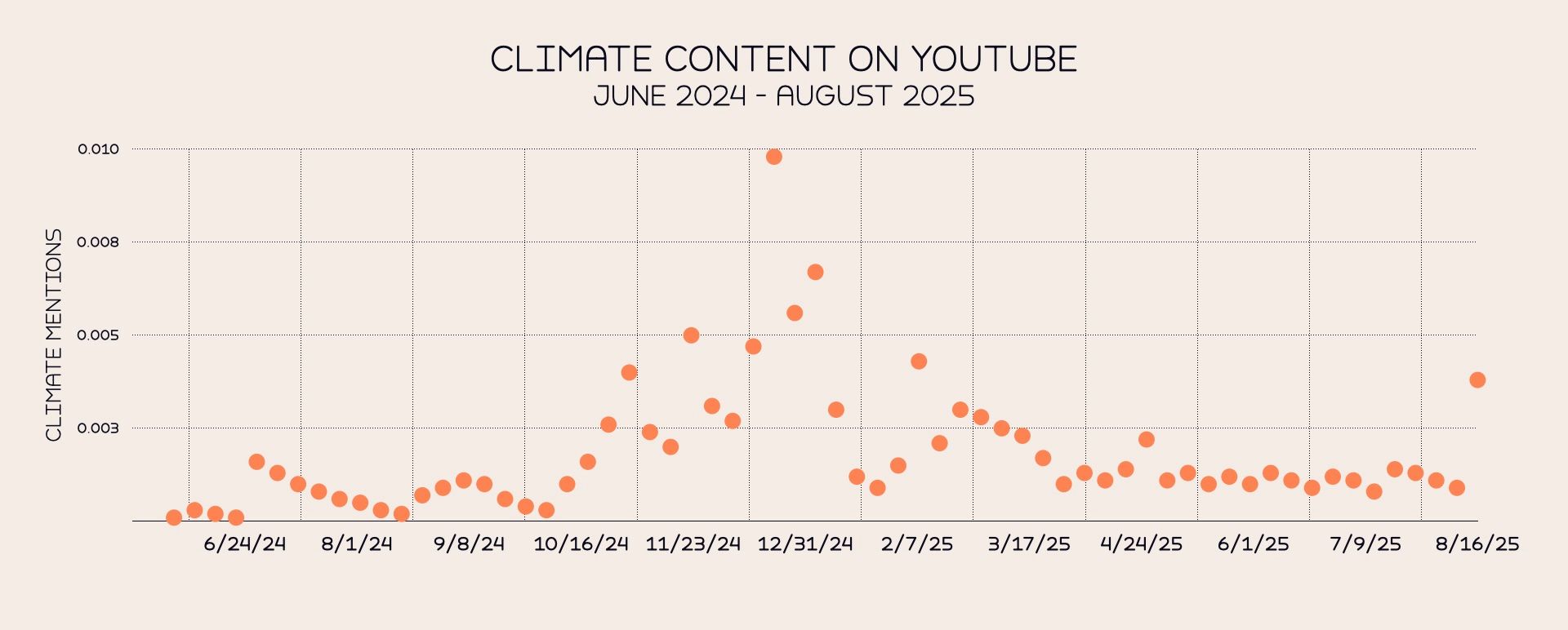 Election season notwithstanding, in the study period we see a pretty steady level of climate discussion in the discourse. Given this, we wondered if the specific topics being discussed had changed.
We coded every piece of media for more than 95 narrative features—everything from who was cast as the hero in the content to what the material system discussed in the content was. Here, we see nearly 50% of the content talking about “information systems.”
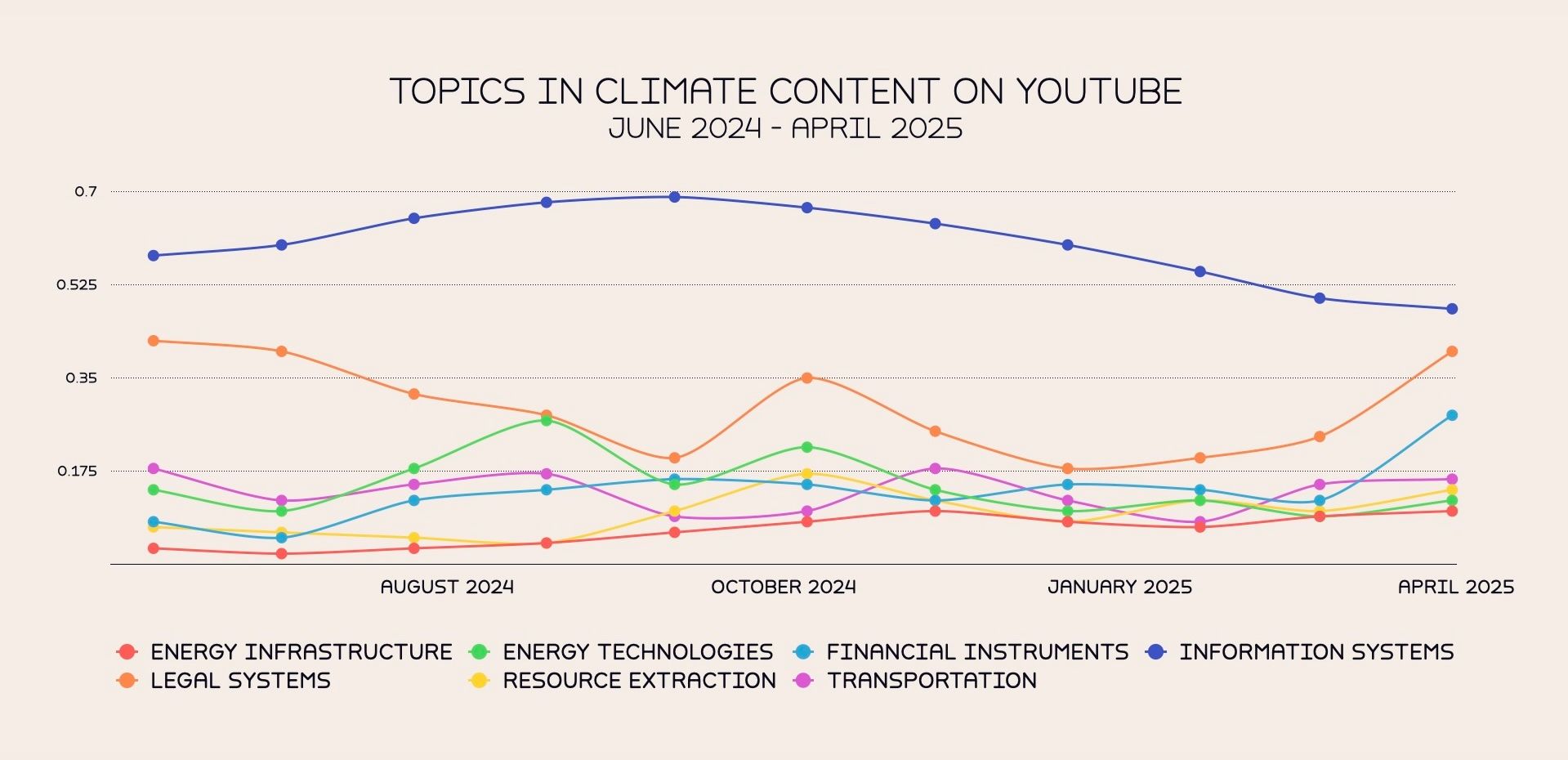 This “information systems” content is essentially media commentary, discussing how climate change is communicated, debated, or covered. Here are some examples:
Beyond this kind of media commentary, no single topic shows dramatic sustained shifts—just fluctuations tied to specific moments. “Energy technology” spikes in August, but that’s largely attributable to one popular video about AI. “Legal systems” gets a bump around the election, attributable to policy discussions like this interrogation of Project 2025.
The takeaway? Topics like legislation or technology trend on very short cycles based on events happening in the world. How we’re talking about it may be more important.
Our recent research on energy transition materials (ETM) offers clear examples of how climate is most likely to reach audiences in the current media environment. In 2025, media featuring ETM moved from niche corners of policy discourse to mainstream conversation. The shift wasn’t driven by interest in ETM themselves or even their climate impact, but by their incorporation into a wide range of larger narratives gaining traction in media–from national security concerns and economic growth opportunities to innovation imperatives and complaints about regulatory red-tape.
Notably, climate-related topics like these become justification for things that would typically be seen as in opposition to one another. In this narrative environment, climate, when it does appear, becomes a convenient backdrop for other political or policy arguments, rather than a coherent issue in its own right.
Two years ago, we identified climate’s distribution problem—it was stuck in the political echo chamber. While that’s still largely true, when nearly half of climate content focuses on media commentary about discourse itself, and when topics like energy transition materials get treated through stories of national security and economic competition, the big storytelling insight is that it’s not the issues themselves that matter so much as the content that carries them. If climate can be absorbed into stories about security and growth, it can also be woven into all kinds of stories that resonate with audiences, including lifestyle, gaming, and other content types.
We still think the big opportunity is engaging people with climate-related content outside of news and politics, expanding the conversation into aligned cultural spaces. And we’ve been developing infrastructure to help storytellers experiment with the kinds of media that can reach these audiences, in these cultural spaces, organically.
For instance, we recently updated our audiences for climate profiles, describing 8 opportunity zones that can serve as inspiration for storytellers hoping to leverage the power of cultural content to connect with audiences on climate. You can explore the climate audience profiles here—we’d love to know if this work sparks ideas for your own climate storytelling.