Capturing Curiosity at the Bad Bunny Superbowl


2026-05-13
In August 2025, MrBeast, Mark Rober, and campaign co-founder Matt Fitzgerald of fitz.partners launched #TeamWater in partnership with WaterAid, mobilizing more than 15,000 creators to raise over $40 million in 31 days—enough to bring clean water to two million people.
Last year, Harmony Labs set out to understand how #TeamWater’s organizing model ushered in a new generation of donors, what funders can learn from it, and how the model can be replicated by advocates, organizers, and campaigners.
Below, you can watch our panel discussion where Kasia Cieplak-Mayr von Baldegg, Director of Creative Strategy & Production at Harmony Labs, sat down with the people who made this campaign possible—#TeamWater co-founder and campaign director Matt Fitzgerald, Telos Media CEO and YouTube creator Oliver Gilpin, and WaterAid CEO Kelly Parsons—and read along with highlights from our newly available case study.
Watch now: Inside the $40M Creator Campaign for Clean Water – The Rise of Creator-Led Fundraising
As a non-profit media research lab, we are interested in helping people use media to shape a better future. Creator-led campaigns like #TeamWater have massive potential for impact, yet we’re only just beginning to explore how they work and why they’re so effective. In our new case study, we looked at why creator campaigns are a uniquely powerful way to reach and mobilize audiences at scale, and we share recommendations for funders and advocacy organizations interested in doing this themselves.
We tracked the performance of more than 19,000 YouTube videos published during the campaign and used our Narrative Observatory—a representative media consumption dataset of 300,000 U.S. media participants—to map top #TeamWater creators to the audiences watching their channels. We also surveyed roughly 960 donors and 420 participating creators to understand motivations, experiences, and what they wanted next.
Among surveyed donors, MrBeast and Mark Rober drove about half of campaign awareness—but our analysis shows the campaign’s reach extended well beyond their core fanbases. Family vloggers, gamers, science educators, and animators brought #TeamWater to audiences across the cultural and political spectrum, from progressive-leaning People Power to more conservative Don’t Tread on Me and Tough Cookies audiences. As one creator told us: “Every creator of every genre was able to turn their niches into a way to promote this fundraiser.”
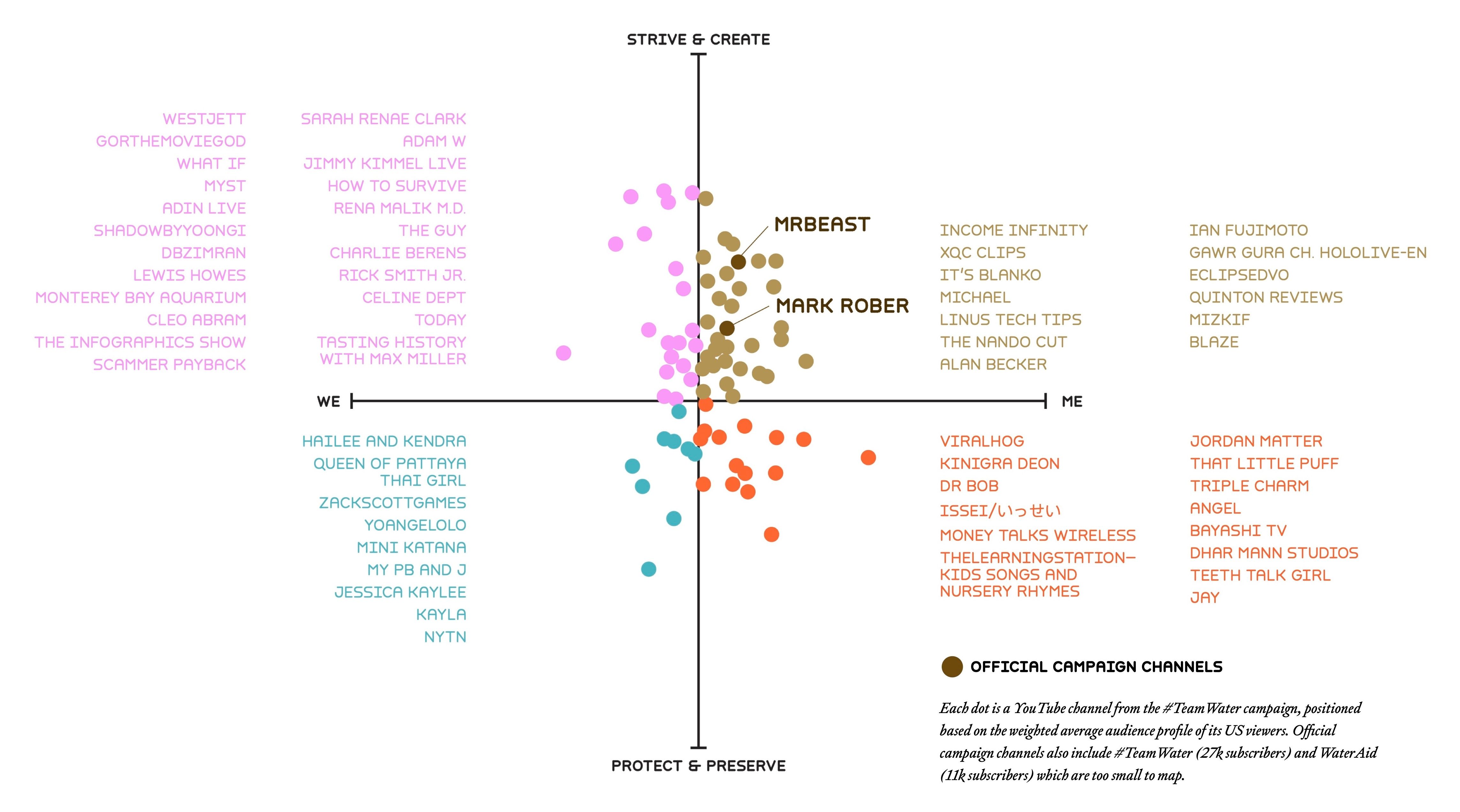 We mapped the channel viewers of participating creators onto our values-based audiences
“$1 = 1 year of water for 1 person” was concrete, nonpartisan, and easy to drop into any creator’s format. Among surveyed creators, 76% said their audiences were equally or more engaged with their #TeamWater content than with their typical posts. While influencer-led charity campaigns can attract criticism for oversimplifying complex issues, #TeamWater’s openness left room for some creators to touch lightly on the theme of water and others to go much deeper.
Leaderboards, livestreams, and creator-led community fundraisers turned audiences into active participants. Through a partnership with Tiltify, more than 1,600 individual community fundraisers contributed, and a single livestream featuring MrBeast, Adin Ross, and xQc on Kick raised $12M in under 24 hours—a charity livestream record. Gaming and crypto communities, where competitive fundraising is already popular, played outsized roles; roughly 25% of all donations came in cryptocurrency.
This may be the most striking finding for advocacy organizations: 99% of #TeamWater donors were new to WaterAid. Among surveyed donors, 62% were under 35—skewing meaningfully younger and more male than WaterAid’s typical base. The donor base spanned worlds: institutional tech giants like YouTube/Google ($2M), Kick ($3M), and TikTok ($1.5M) gave alongside children donating allowances, gaming communities pooling contributions, and even an OnlyFans creator. #TeamWater received over 100K donations in all with $5 being the most common amount. The easy-to understand fundraising formula ($1 = 1 year of water) was easy to share via social media, encouraging small donations and broad participation.
Among surveyed creators, 89% said they were “extremely” or “very likely” to participate in a similar campaign in the future; among surveyed donors, 76% said the same. Both groups described wanting to stay involved beyond the campaign window—through volunteering, ongoing impact updates, and tangible ways to show their affiliation.
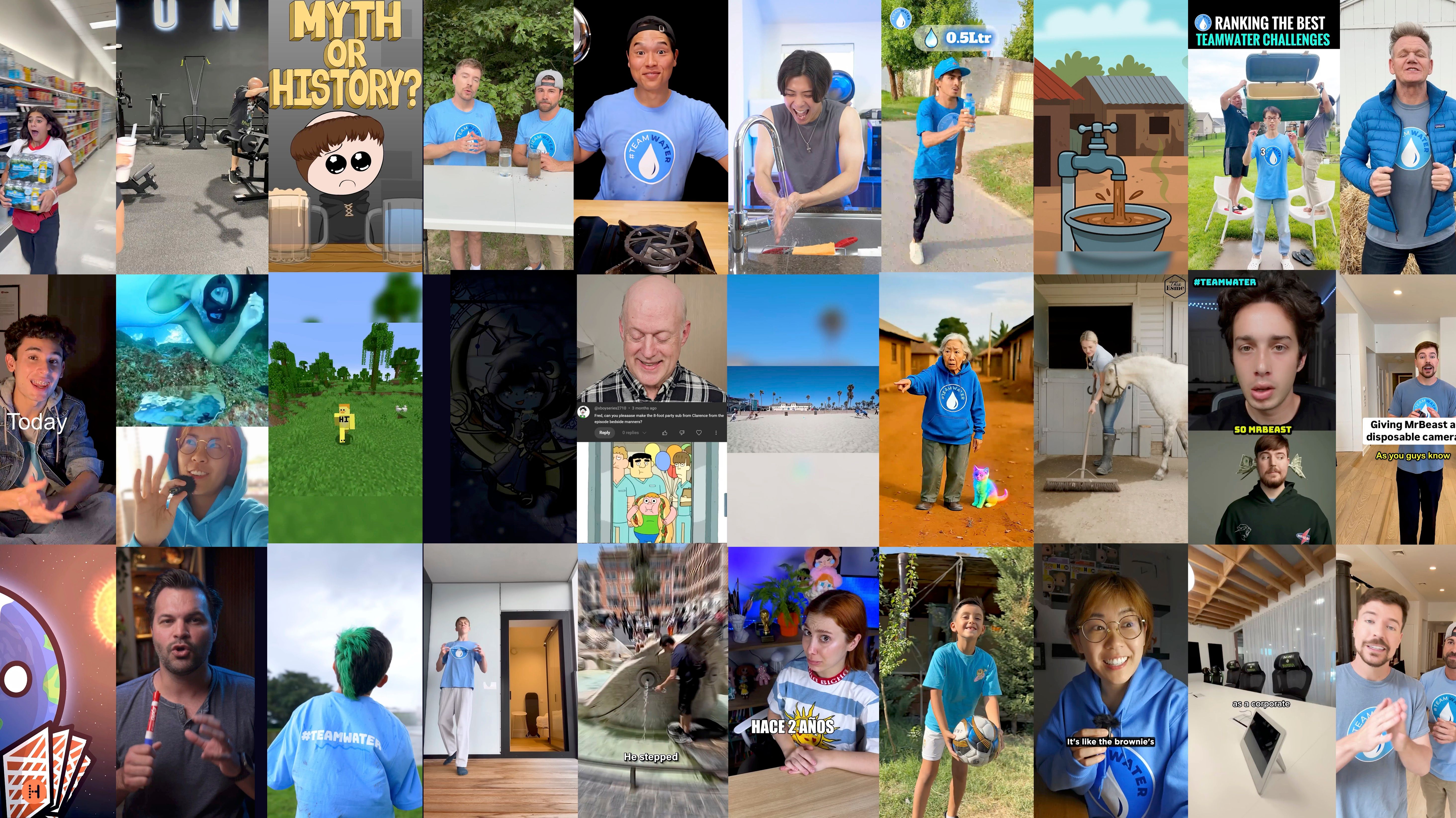
We set out asking whether creator-led campaigns could help advocacy reach new audiences. The findings suggest they can, especially when funders and organizations expand their existing toolkit with new approaches. Four takeaways stand out:
#TeamWater shows that creator-led campaigns can mobilize audiences traditional advocacy channels miss—and that the model is replicable beyond the singular pull of MrBeast. For organizations thinking about how to engage new audiences in today’s fragmented media landscape, our new report #TeamWater Makes It Rain is worth a closer look.