From Prototype to Practice: New Tools for Unlocking Audience Insights

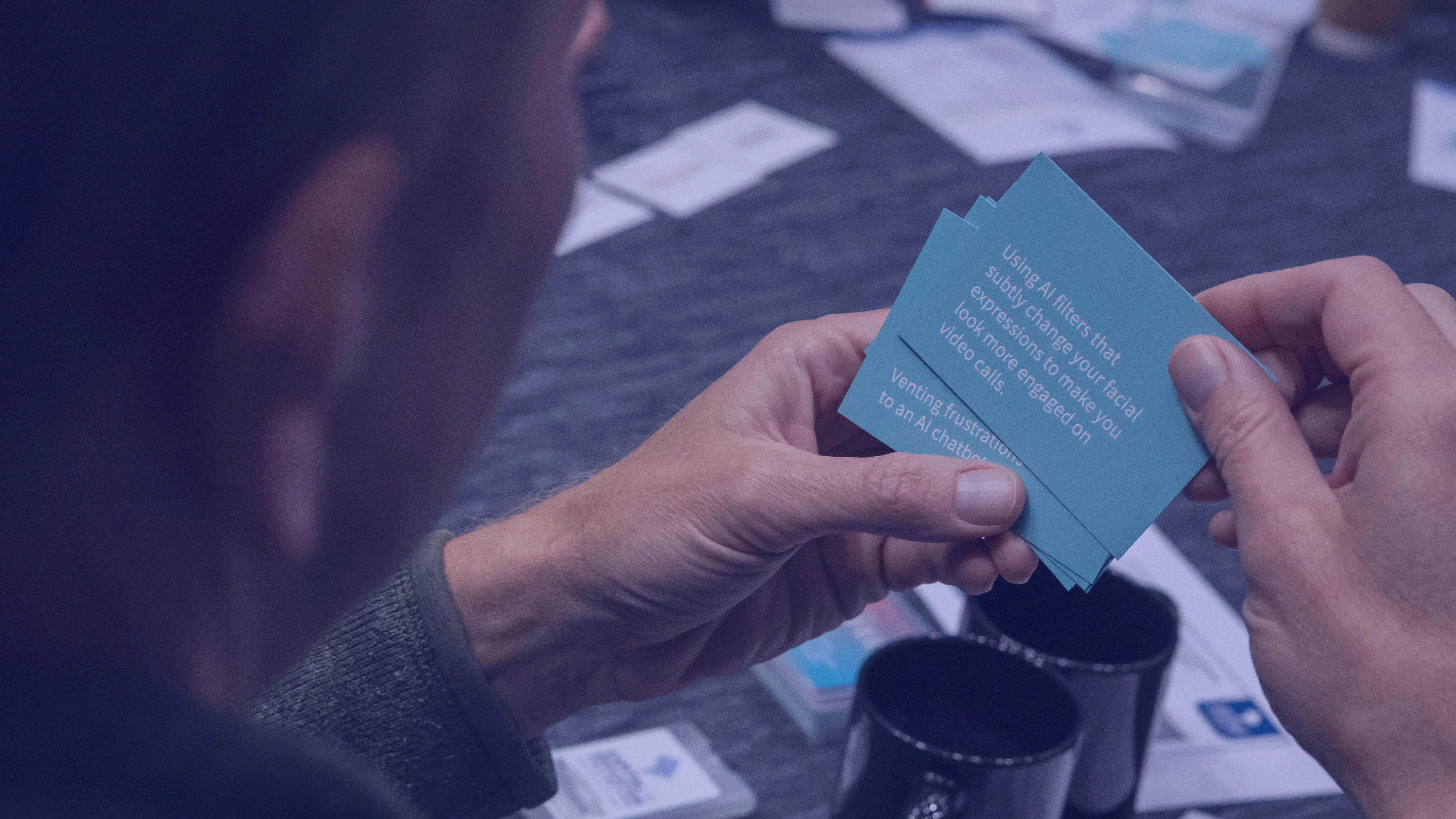
2026-11-16
Rob Strain leads strategy and the Creative Studio for The Rithm Project, a youth-focused organization working at the intersection of human connection and AI, and a member of the Narrative R&D Lab’s Community of Practice. The Rithm Project aims to reverse the trend toward isolation by helping the next generation use AI in intentional ways that support, rather than erode or replace, meaningful relationships. From Substack essays to immersive theater and games teens can play, Rob and the team translate research into experiences and content that travel and shape discourse.
Here we spotlight The Rithm Project’s work with the Lab: first, how the team remixed the Lab’s shared narrative goal on AI to fit their relational lens and turned it into a hands-on exercise, and second, how one of their earlier projects, The AI Effect card game, has been reinterpreted for new content with Buzzfeed.
The narrative landscape still tends to treat AI as a tool that changes how we work, learn, and operate, but often underplays how it’s reshaping the relationships that sustain a thriving life and society. That technological shift is arriving at a time when young people are increasingly isolated and are still working out what social media has meant for their friendships.
Meanwhile, the public conversation swings between AI as utopia and AI as doom, rarely making space for a thoughtful middle ground that centers choices we make about how we use this technology, and the boundaries we want to put on it. The Rithm Project’s work lives in those grey areas. AI will bring real possibilities and risks, and their work is to help people weigh both for themselves.
So far, The Rithm Project has developed nuance and discernment most effectively through deeper experiences such as facilitated spaces, evocative games, and intimate conversations – spaces that not only offer provocation, but create a container for reflection, weighing trade-offs, and hearing other perspectives. Shifting broader cultural narratives, however, means reaching more people, often through short-form media that can feel glib. That is the tension and creative challenge Rob’s team brought to the Lab:
Earlier this year, the Community of Practice drafted and pressure-tested a shared narrative goal for AI. It is organized into four beats and intended to serve as a common benchmark for different members’ narrative experiments:
The Rithm Project’s work sits most naturally in the second and fourth beats about urgency and societal agency respectively. It helps people get clear-eyed about AI’s relational benefits and risks, and it protects the parts of life that make us most human.
The narrative goal development process also pushed The Rithm Project team further. If they focused only on the relational thread, what would their own version of the four beats be?
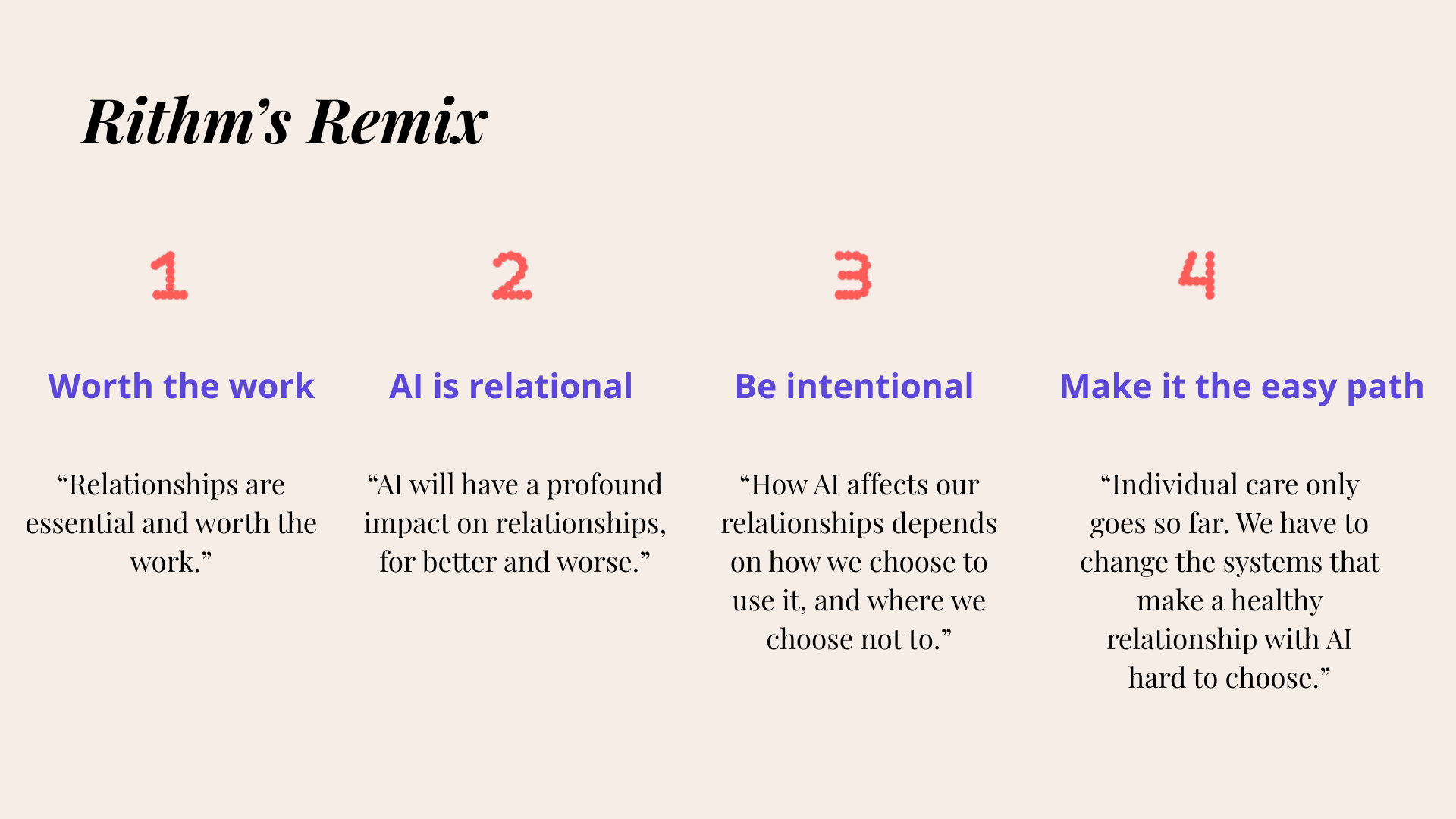
The Rithm Project found the beats useful enough to put them on the table, literally. At a team retreat with several of their youth fellows who were shaping the organization’s strategy, the team broke each beat down into smaller, more contestable ideas for an interactive sorting exercise.
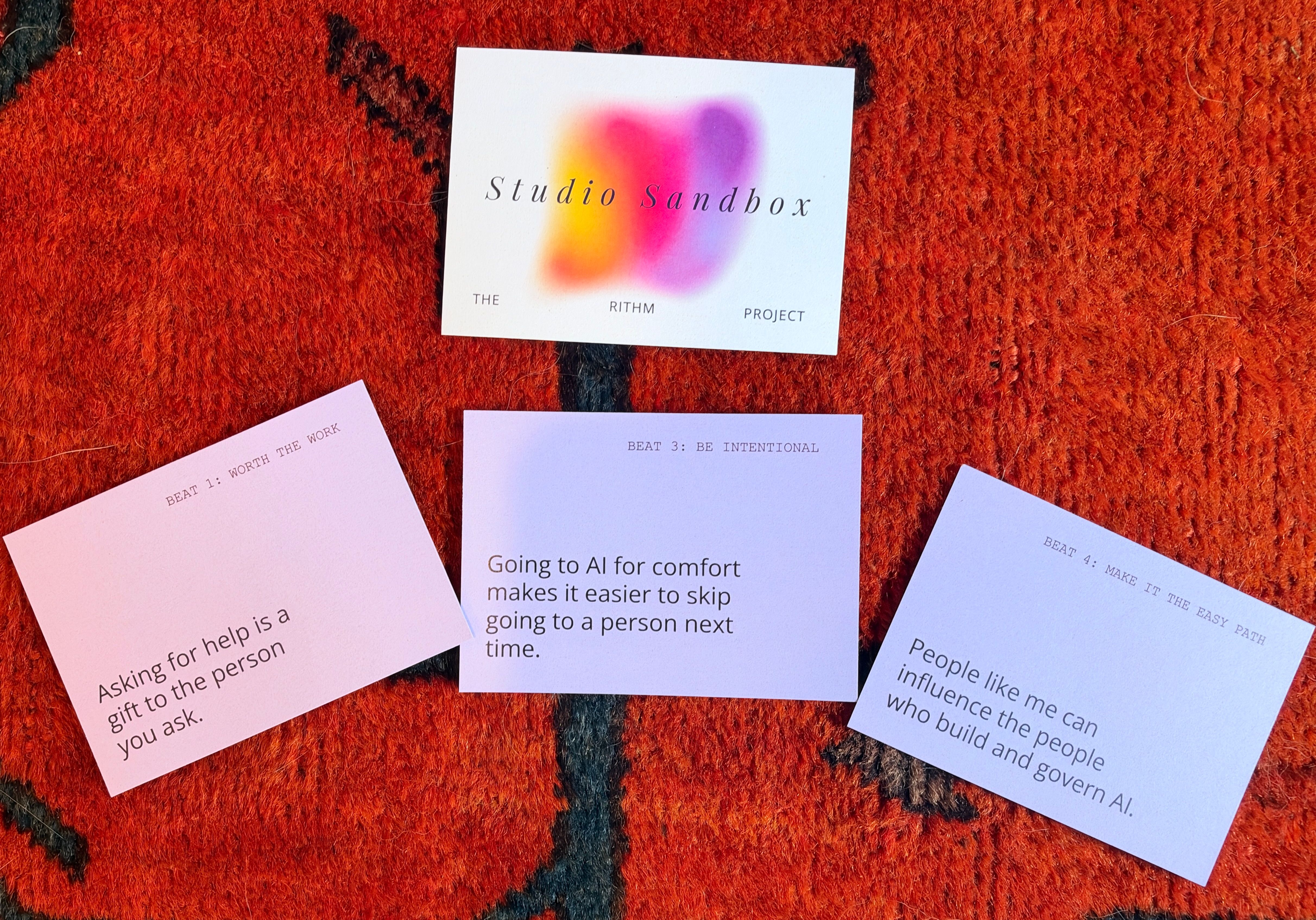
Participants sorted those ideas into groups of ideas that their peers would agree with, that are contested, or that people might say they believe but don’t act on.
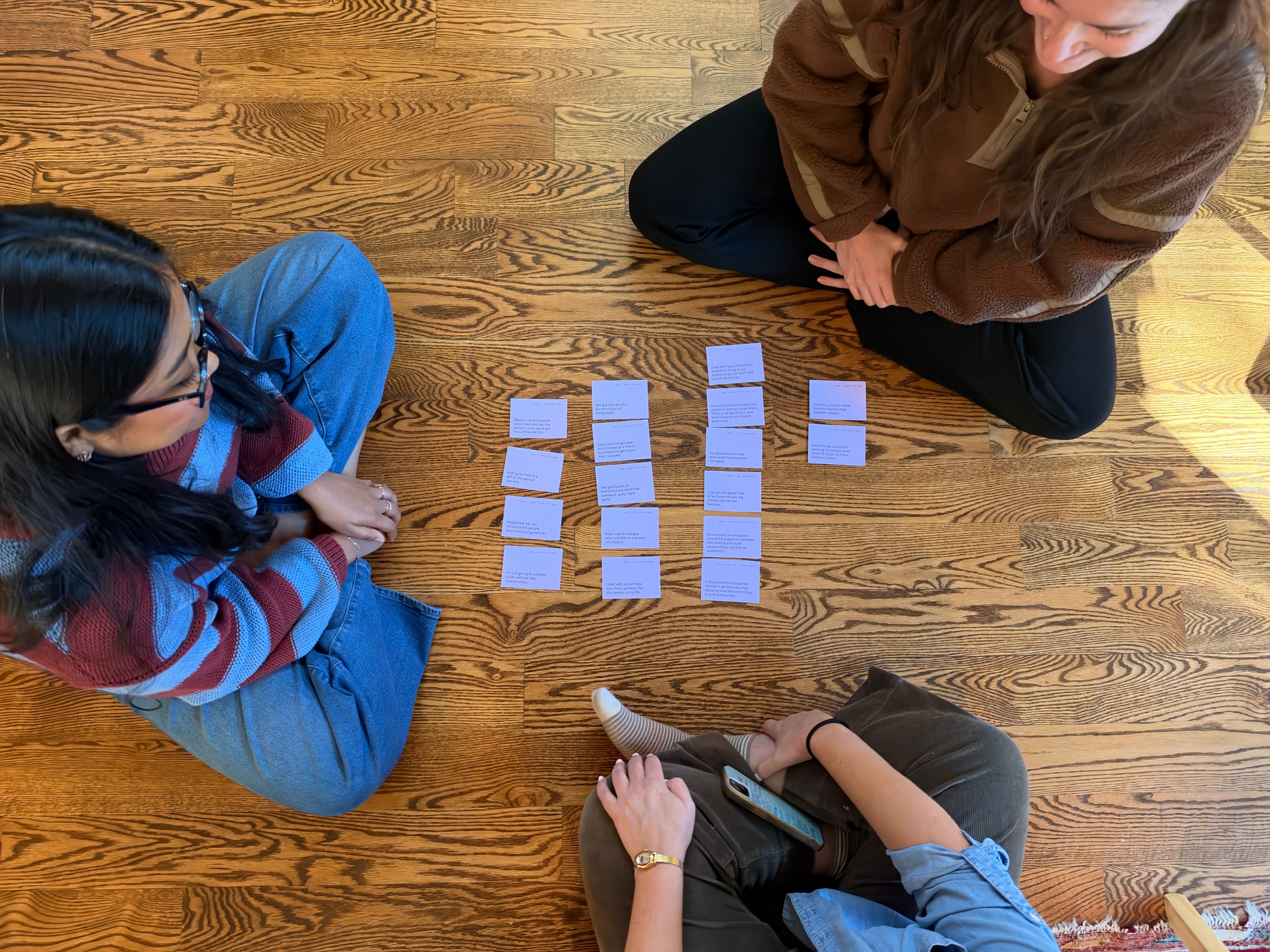
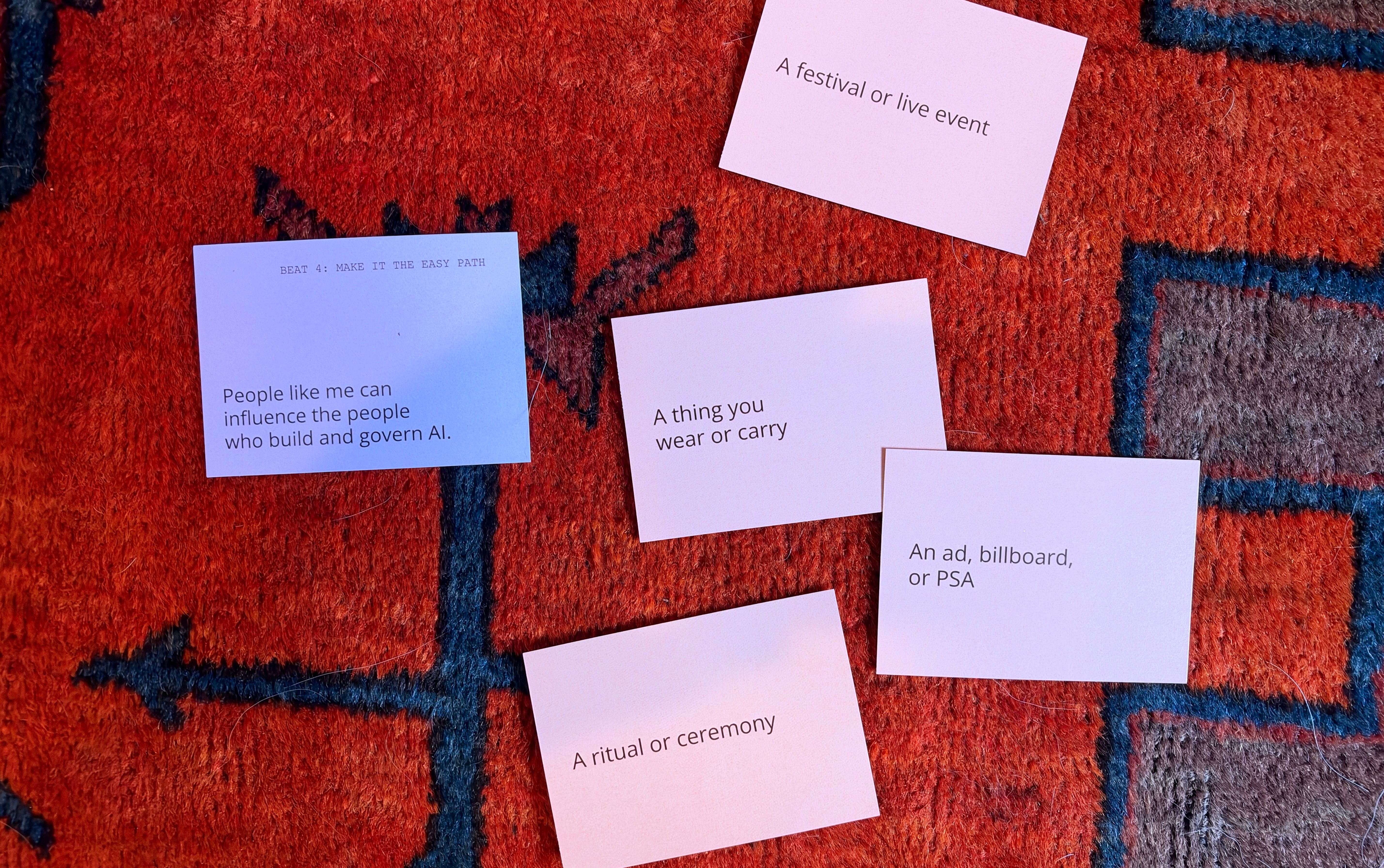
The exercise surfaced where the team agreed and where it didn’t, and helped them name a few beliefs worth moving in 2027. They then brainstormed formats that could carry those beliefs onto the Creative Studio’s roadmap, from a PSA to a music festival to a community ritual.
Some of those ideas may end up in production next year. The more useful result was what the exercise did to the goal itself. A high-level narrative statement became a set of claims their coalition could argue with, prioritize, and act on.
The beliefs the team identified as furthest from the mainstream centered on agency: the sense that the choices people make can meaningfully shape what this technology does. Over the past two years The Rithm Project had put most of its effort into building awareness of AI’s relational impacts, good and bad, and those ideas were starting to show up in mainstream content and sentiment. But awareness was arriving without power. People reported seeing the risks clearly and feeling unable to do much about them.
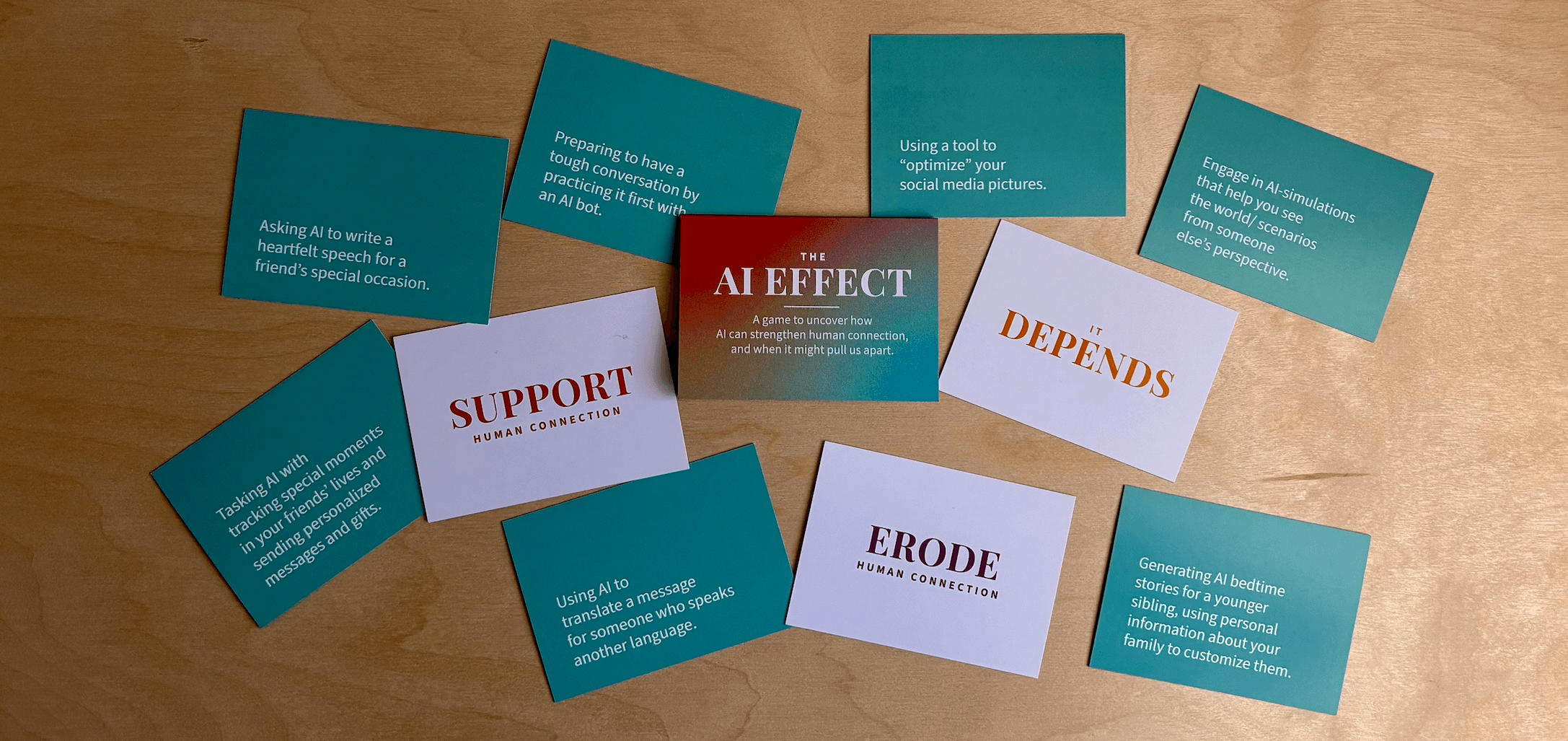
They already had a tool for that gap. The AI Effect is a card game, played by roughly 30,000 people to date, that asks players to look at the everyday decisions they make with AI and the wake those decisions leave in their relationships.
Each card presents a real use of AI, and players discuss whether it is more likely to support their relationships, erode them, or whether it depends. One asks whether AI writing a birthday note to a close friend changes what it means. Another asks whether you would send an AI avatar of yourself to a family reunion. The game is designed to be played across generations, and it reminds players that these are choices they get to make.
The game’s concrete prompts made it a natural fit for the Lab’s creative brief process. Harmony Labs brought the concept to content partner BuzzFeed, known for producing relatable, conversational content about digital culture and lifestyle.
The resulting content is now live. In one video, a young creator known for social experiments on himself spends 48 hours trying to replace every human interaction, service, and relationship in his life with AI. Then he reflects on what he missed and how relying on AI affected his relationships. BuzzFeed also produced a video podcast episode and short clips in which hosts play The AI Effect, discuss The Rithm Project’s work, and reflect on the prompts.
Much of The Rithm Project’s work aims to help people hold complexity. AI is neither only terrible nor only amazing, and navigating it takes reckoning with short and long-term trade-offs—a stance that’s hard to fit into a short-form video format that tends to reward hot takes. With these pieces of content, the team hopes to learn whether content can hold nuance in a way that feels actionable rather than paralyzing, and whether a discernment compass can shift beliefs the way a verdict can.
Harmony Labs is now testing the content to see whether it moves beliefs on survey questions tied to the four narrative goal beats. Stay tuned for results. In the meantime, you can learn more about The Rithm Project’s work on their website, or join their mailing list to be the first to access their newest research and tools.
We’ll share what we learn from content testing, along with more experiments from the Community of Practice on making and testing AI-related content with different audiences. To follow along, sign up for the Harmony Labs newsletter. If you’re working on a similar narrative experiment, get in touch with Lab director Rob Avruch.