Capturing Curiosity at the Bad Bunny Superbowl

2026-09-22
The AI conversation is broad, fast-moving, and frenzied. Researchers leaving the major companies warn of catastrophic risk, some of the industry’s own leaders have endorsed slowing the pace of development, lawmakers across the political spectrum are converging on the need for oversight, and the Pope’s first encyclical called for AI to be “disarmed.” There’s no shortage of discourse about where AI is taking us, but very little agreement about where we want it to go.
Over the past year, Harmony Labs has been convening a community of practice as part of the Narrative R&D Lab to bring together researchers, creators, funders, and organizers working on the stories we tell about artificial intelligence, both as a subject (which stories move which audiences) and as a tool (how AI integration can improve the narrative strategy workflow itself). One of the first things we set out to do together was to establish a narrative goal: a shared destination that our community of practice’s separate experiments could all be measured against. Here we surface some of the challenges, opportunities, and considerations shaping our first year of AI narrative work.
The landscape is shifting faster than our collective ability to understand it, let alone tell good stories about how this technology is reshaping everyday life. Meanwhile, practitioners are running a wide range of experiments without a shared way to know what’s working. Each organization sets its own definition of success or progress.
At Harmony, we define a narrative goal as the minimum viable set of beliefs and attitudes that everyone would need to hold for our work to have succeeded. If we reached every audience, on every platform, with all the stories this community of practice and others are going to make, what would people believe at the end of it? That’s what a narrative goal tries to capture. It isn’t a message or a script. It gets embodied in different ways, for different audiences, by different creators, in different stories. A narrative goal allows us to tell the many stories that reach people where they are—especially people whose values, attitudes, and beliefs differ from our own.
We wanted a goal that did three things. It had to:
In other words, defining a narrative goal was about focusing our AI research, channeling a wide range of expertise toward a common goal, and setting clear benchmarks to measure our progress, even as conditions around us evolve. While the landscape will inevitably shift with new stakeholders and changing priorities, establishing these reference points gives us a foundation to build on and track our advancement.
We started with an onboarding questionnaire for our working cohort of 18 narrative practitioners, creators, AI domain experts, researchers, and funders who are each running their narrative campaigns through the Lab’s testing infrastructure, asking what beliefs about AI narratives go underdiscussed in their fields, who they hope this work reaches, what they would like everyone to believe, and what the world looks like if we get there.
We then cast a wider net with the same questionnaire and heard back from 24 additional people spread across a wide range of domains, including academia and AI research; media, journalism, and creators; politics, democracy, and civic life; education and families; digital wellbeing and youth; philanthropy and funders; film and documentary; narrative and civil society; and tech and AI industry. Our thanks to everyone who contributed.
We coded their responses, pulling out the strongest recurring beliefs, and brought eight candidate beats for a narrative goal to the community of practice through two virtual workshops where we voted on the most salient beliefs. We pressure-tested these early signals by checking if every beat showed up in the community of practice’s early narrative experiments, in their own words. If a beat was too abstract to appear in anyone’s experiment, it needed refinement.
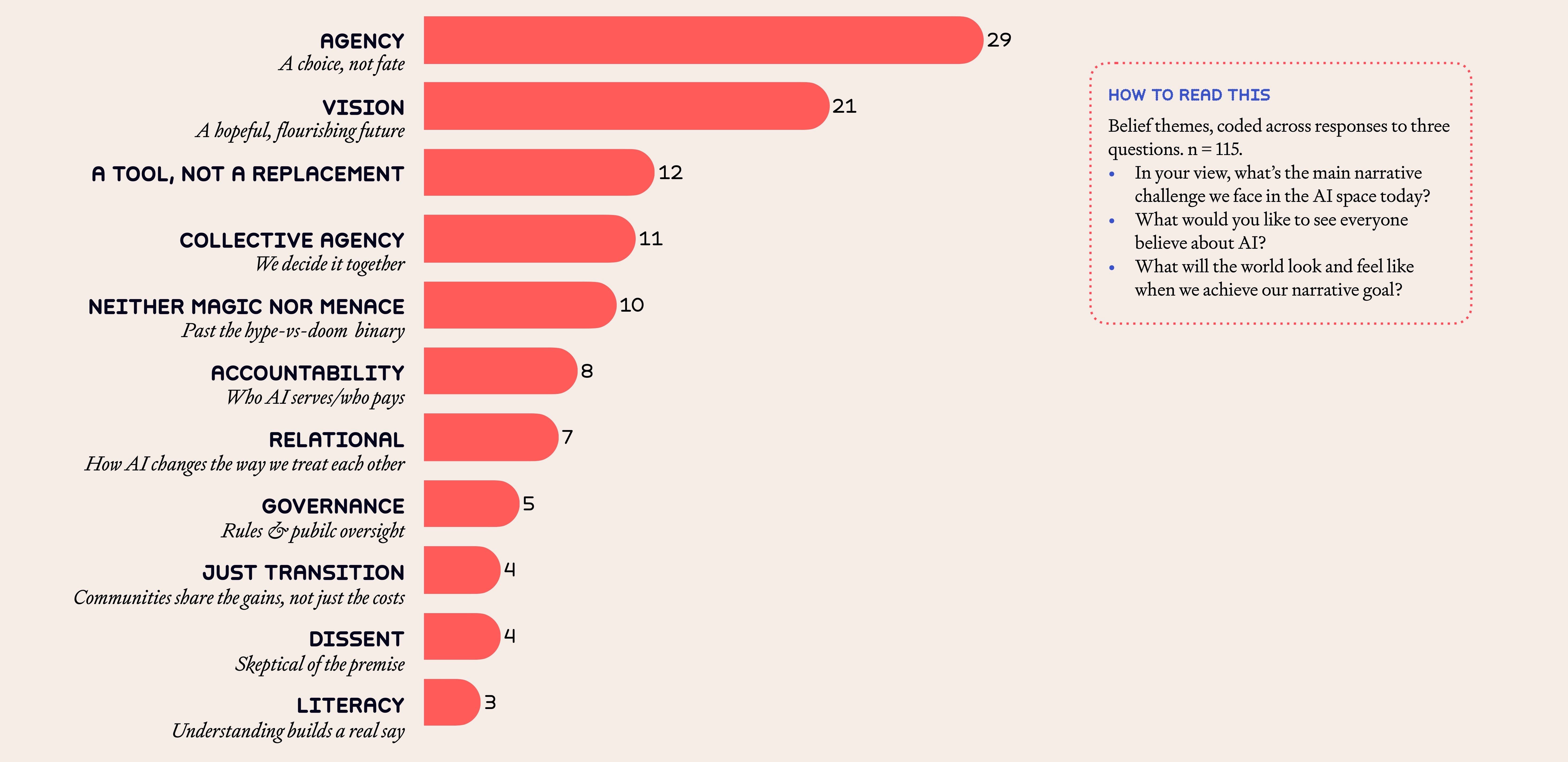
Here are the themes that came up most often across 43 respondents, coded against three questions that ask what people believe. Agency stands out by a wide margin: the idea that AI is a choice rather than fate, something we shape rather than something happening to us.
Each beat is a move from one state to the next that assembles into a larger narrative goal: from dread to desire, hype to readiness, powerlessness to agency, and drift to flourishing.
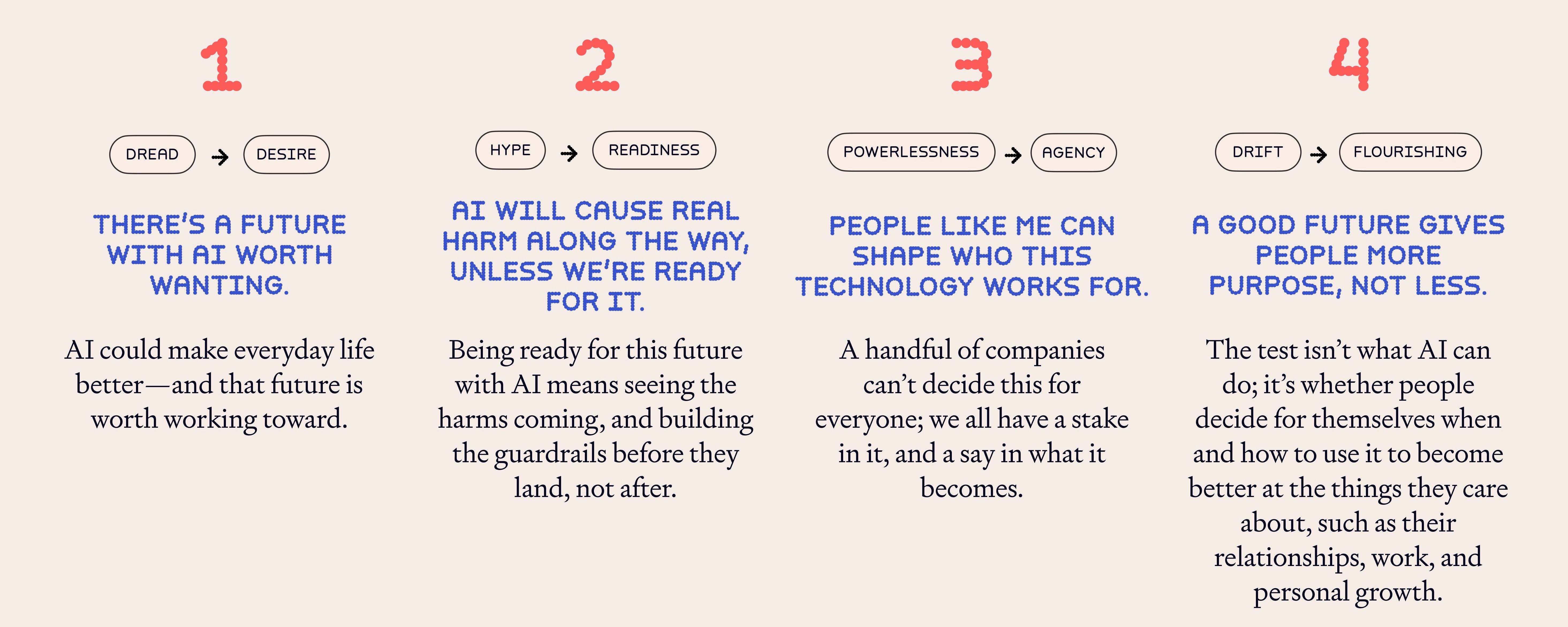
Dread to desire: There’s a future with AI worth wanting.
A future where AI enriches everyday life is possible, and worth working toward. Right now most public conversation about AI is about what could go wrong, which leaves little room to ask what AI could make possible. One respondent described the balance we’re after as “a healthy sense of both fear of an unbridled space, and opportunity for the problems it is going to be able to solve.”
Hype to readiness: AI will cause real harm along the way, unless we’re ready for it.
Excitement about AI doesn’t equal preparation. Being ready for this future with AI means seeing the harms coming and building the alignment guardrails before they land. As one participant put it: “An actionable shared framework for deciding what we want these technologies to make possible has yet to emerge—without one, we risk leaving the narratives beneath our decisions unexamined.”
Powerlessness to agency: People like me can shape who this technology works for.
A handful of companies can’t decide this for everyone; we all have a stake in AI, and a say in what it becomes. One contributor framed the stakes as: “The question is whether we feel like the hands shaping the clay—with a sense of agency and intentionality—or whether we feel more like the clay itself.”
Drift to flourishing: A good future with AI gives people more purpose, not less.
Success right now is measured by what AI can do—benchmarks, capabilities, and tests it can pass. The real measure is whether people can decide for themselves when and how to use it to become better at the things they care about, such as their relationships, work, and personal growth. Another participant described the outcome as: “Deeper human-to-human connection, less judgment, less sickness, more peace, better access to resources.”
This highly collaborative process was also part of an ongoing experiment in how a narrative goal gets made. It used to be that we arrived at a narrative goal through a literature review, then brought the draft to a panel of advisors or subject matter experts for review. Here, a group of experts from many domains was with us at every stage of development—responding to the questionnaire, coding the responses into themes, workshopping the statements over two sessions, and testing the beats against their own experiments. We found that a narrative goal drafted this way is more widely representative, and better pressure-tested than one reviewed at the end. That it also came together in weeks rather than months was a bonus.
We wanted to know whether the resulting narrative goal could be broad enough to be used as a benchmark for many organizations’ campaigns but specific enough to guide research and content testing. So far, yes. Education, media, policy, civic engagement—they all found language in it they could use.
We were also curious what being cross-disciplinary would mean for the four statements that represent the beats of our narrative goal: whether more perspectives would sharpen them or water them down by overloading them with too many concepts. Some of both, it turned out. Considering different organizations’ focuses helped us cut eight candidate beats down to four, and testing them against members’ ideas for experiments caught the places where the language was too abstract to act on.
The real test is whether the stories we make transport people toward the narrative goal—that is, whether audiences’ agreement with these four statements shifts after they encounter content built around them. For the rest of the year, members of the community of practice will be running a narrative experiment by making actual pieces of content and evaluating them against these four beats as a shared measurement framework.
We’ll be sharing what we learn as these campaigns are deployed and tested. If you’d like to follow along, sign up for the Harmony Labs newsletter. If you’re working on narrative goal-setting in your field, we’d like to hear how you’re approaching it. Get in touch with Lab director Rob Avruch.