Capturing Curiosity at the Bad Bunny Superbowl


2026-04-07
To be human is to shape what happened into stories. We do this often without noticing, without intention or effort. Over time, the stories we encounter and tell ourselves again and again gain coherence and weight. They form a fabric, exert a gravity, create an arc, a shapeliness that bends and inspires the line of our lives, difficult to escape.
This deep internal patterning, which gains strength as we age, we refer to as “deep story.” It’s what we reach for when we lose a job, or get a disease, or fall out of love, to explain to ourselves why me, why now, why this. If narratives are the story patterns that emerge from people’s interaction with the world and, more specifically, with media content, then deep story is what emerges from people’s reasoning over and over, through their values, about who they are and how the world works. A deep story is like values tied up in a coherent syntax, an operating system that sits underneath and makes possible all the applications we interact with on the surface.
The partners we work with tend to want to change the story. The story that makes us a nation. The story that explains who succeeds, who governs. The story of injustice, inequity, repair. To change the story, they tell more stories, aimed at particular people, particular groups of people. Those stories connect with and resonate with people, or not. They fit together with people’s existing stories, or not. They sync up, or not.
Change depends on this resonance, this fitting together, this syncing up. It derives less from convincing or persuading rational actors, than from a listening and a telling, a call and response, a deep electrical interaction within and across bodies, through people, over time and space. Knowing, tapping into, hitching our stories to the deepest stories people carry with them: this is what creates the critical mass of societal change.
At least that’s how we’ve come to see it. And that’s why a year ago we set out to build a survey instrument we could use, together with the respondent-level media consumption data in the Narrative Observatory, to uncover audiences’ deep stories. We called it the Deep Story Survey System.
To articulate deep stories required a container for synthesizing all the stories people were choosing in the media and drawing from in their survey responses. To create one we read a lot of narratology. We experimented. We talked with experts. We were inspired by Aristotle’s Poetics and Rhetoric, by the work of narratologist Vladimir Propp, by Griemas’ Actantial Model, by Smith and Decoster’s work on dual processing, by Hochschild’s Strangers in Their Own Land, and by the work of many others.
We created a deep story structure describing the parts of a story, and then we tried to use it across projects covering democracy, gender, climate, healthcare, and more. Finally we arrived at the below story structure, which gets at the three primary elements of deep story: the world which is its setting and rule giver, the characters who inhabit and shape it, and what happens as a consequence.
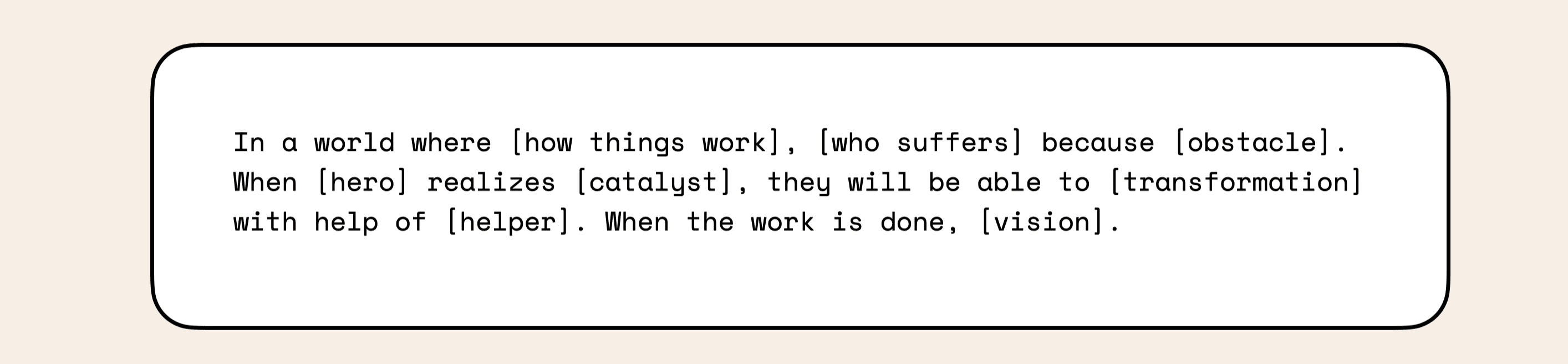
You can read about the democracy stories we found through this way of working in this report. Our work on gender is forthcoming. And here’s an example of the economic mobility story we synthesized for the Tough Cookie audience, along with a few of the open-ended survey responses the story draws from:
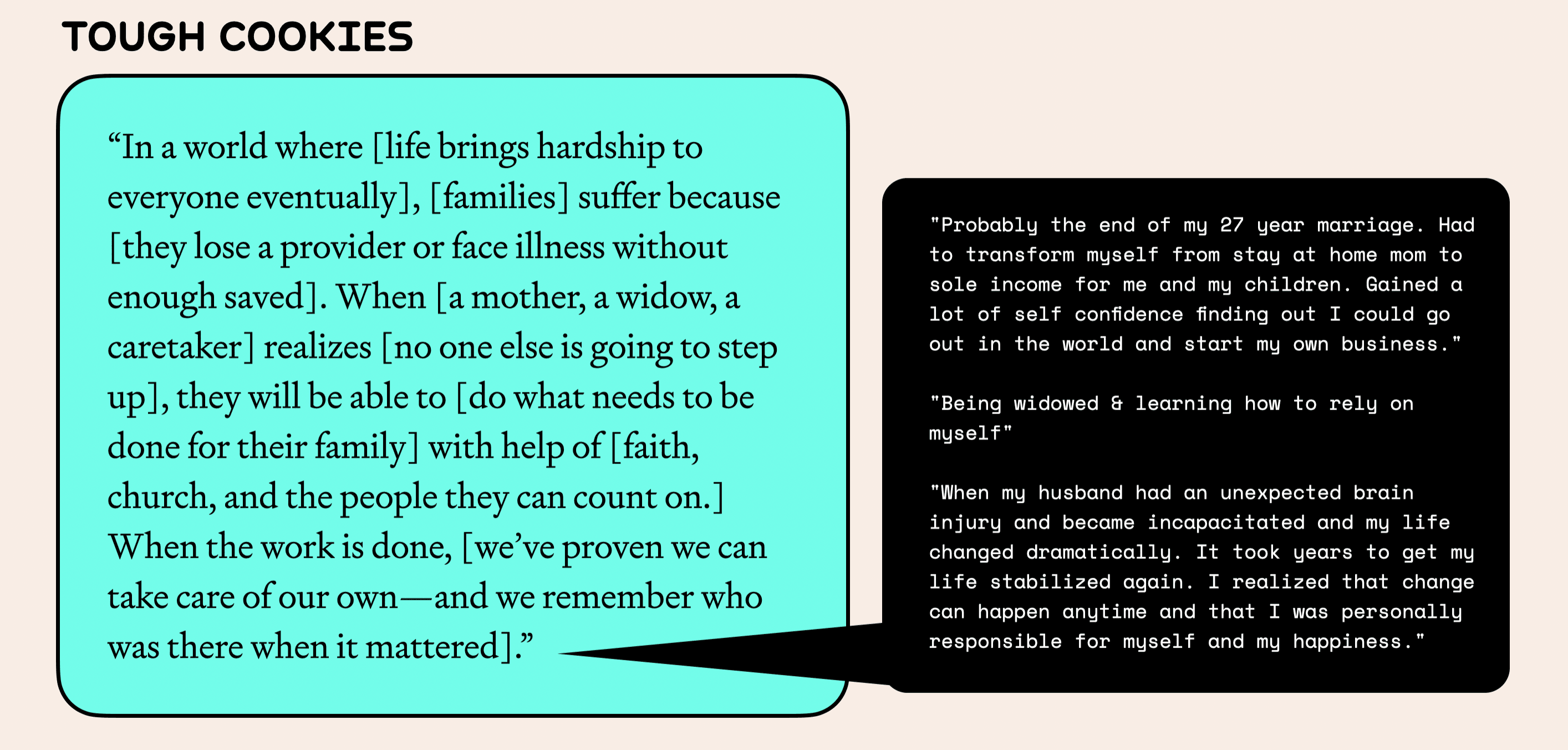
To get underneath these individual topics and into the deepest deep story for each audience, we further synthesized and condensed across topics. For Tough Cookies that yielded a story called, The Inheritance. It talks about holding the line, about time as a refining force, about what endures being what we ought to preserve and cherish. You can read other audiences’ stories too, below.
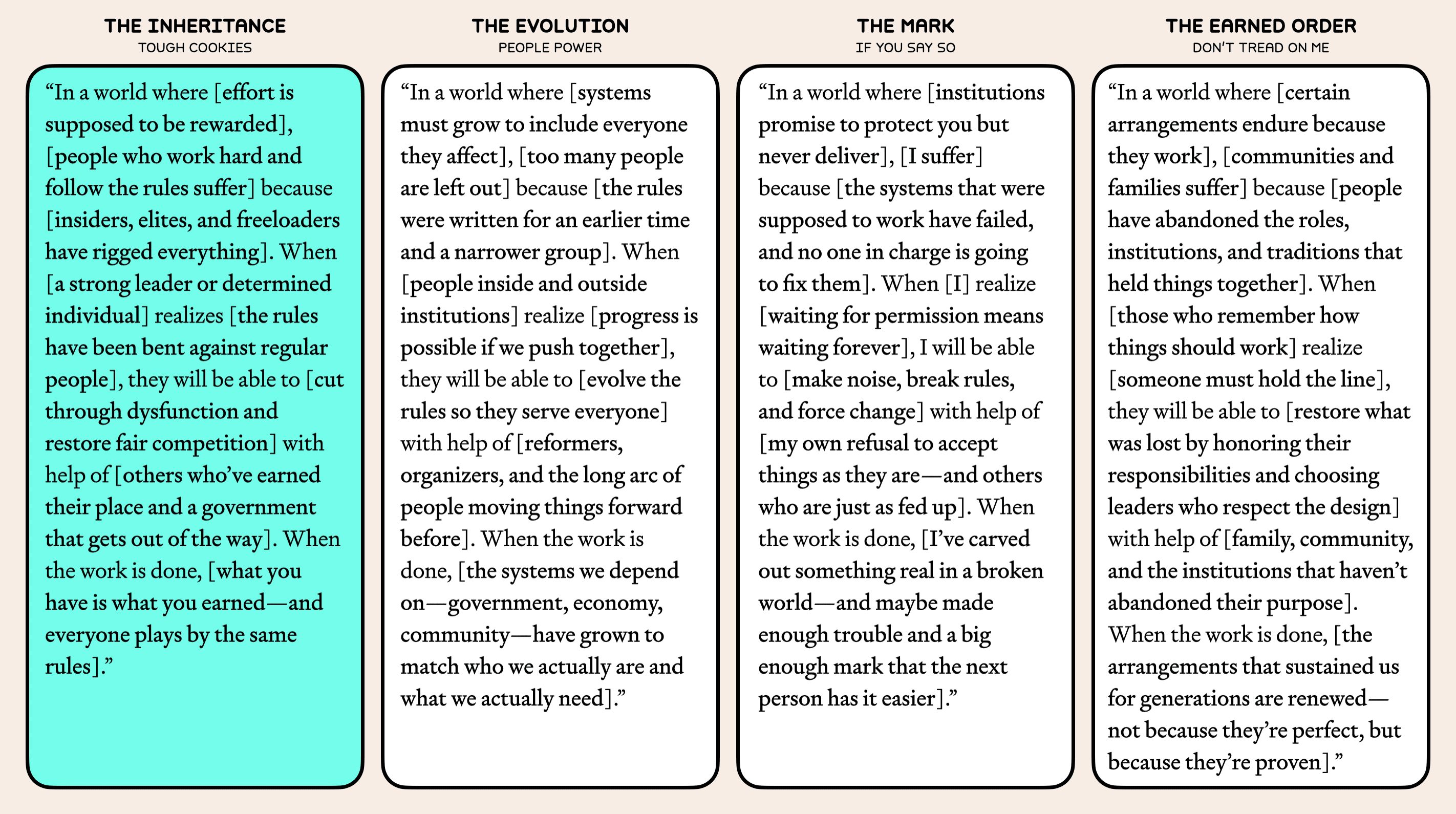
We cannot rewrite audiences’ deep stories in our effort to change the collective stories we share. Rather, we must fit our change work inside of those stories. We must position our change story as their natural consequence. For Tough Cookies, this means a story about how tradition actually requires the change we want to see. For People Power, it means a story about how that change is a natural next step in the direction of progress. For Don’t Tread on Me, it means a story about how the change clears away obstacles for hard-working people. For If You Say So, it means a story about the change as the occasion to make noise and finally make a mark. Same change. Four different stories. Four different entryways to engage. Four different pathways.
In the year ahead we plan to keep experimenting with how we extract and articulate deep stories from our research findings and behavioral media data. These deep stories came from five national surveys Harmony Labs conducted last year with our Deep Story Survey System, with more than 10,000 respondents, 300 quantitative questions, and 11 open-ended questions, in addition to scans of per audience streaming behavior from the Narrative Observatory. Please get in touch if you’d like to learn more or start a conversation.