Capturing Curiosity at the Bad Bunny Superbowl

2026-10-01
When people search for news or pop culture online, Wikipedia is one of the most popular landing spots. In our 2024 research on how Latinos find information online we called this predictable moment “capturable curiosity.” Informed by this research, Maremoto built a narrative strategy to capture the cultural moment that was the “Benito Bowl,” aka Bad Bunny’s halftime performance at Super Bowl LX. The result? 16.6 million measurable impressions on critical civic engagement content.
In 2024 Harmony Labs teamed up with Equis to understand how U.S.-based Latinos find information online. The ultimate goal for Equis was to embed a culture of civic engagement into the internet to ensure Latinos encounter accurate and timely information, in Spanish, so they can make informed decisions about the world around them. What our research made clear was that civic life online is about errands, not civic engagement. People interact with policy and government all the time, but it’s in search of things they need, everyday interactions with their communities, their local government, and safety nets, as they seek out basic information about things like rent, stocks, money, and cars.
Early attempts to redirect this behavior through SEO, or, more recently, GEO and AEO, were not yielding significant benefits in increased online civic engagement. The research found the internet already has a shape that has grown to address people’s existing curiosity—and trying to create entirely new destinations actually distracts users from the platforms and outlets they already trust.
One of the key destinations that Latinos reliably land on around news and cultural moments is Wikipedia. Knowing this, Maremoto, an organization founded in 2025 by Equis alum and community organizer Jess Morales Rocketto that uses narrative change to inspire Latinos into collective civic action, set out to make a strategy for Wikipedia to take advantage of these moments.
When Bad Bunny was announced as the Super Bowl LX halftime entertainment, Maremoto recognized it as a predictable moment of “capturable curiosity” and, inspired by Harmony’s research showing 27% of all popular culture and news searches end up on Wikipedia, made the site their narrative priority.
Maremoto discovered that only 3.2% of Wikipedians are Latino, so the first step was a recruitment and strategic effort that helped Maremoto improve the articles most likely to generate traffic from this event. They focused on three content areas—the Super Bowl LX halftime show article, Bad Bunny’s discography, and related immigration articles.
The team made neutral-point-of-view edits that wove together three narratives Maremoto wanted its audience, and Latinos specifically, to encounter: Latino economic power; Latino solidarity; and, Bad Bunny as a galvanizing force for a shared, collective Latino identity. In one example, they took an article that had focused on the “controversy” of Bad Bunny’s selection and used actual quotes from league leaders to share a more balanced perspective, including that the selection was a recognition of the power of Latino fans as an audience for the NFL.
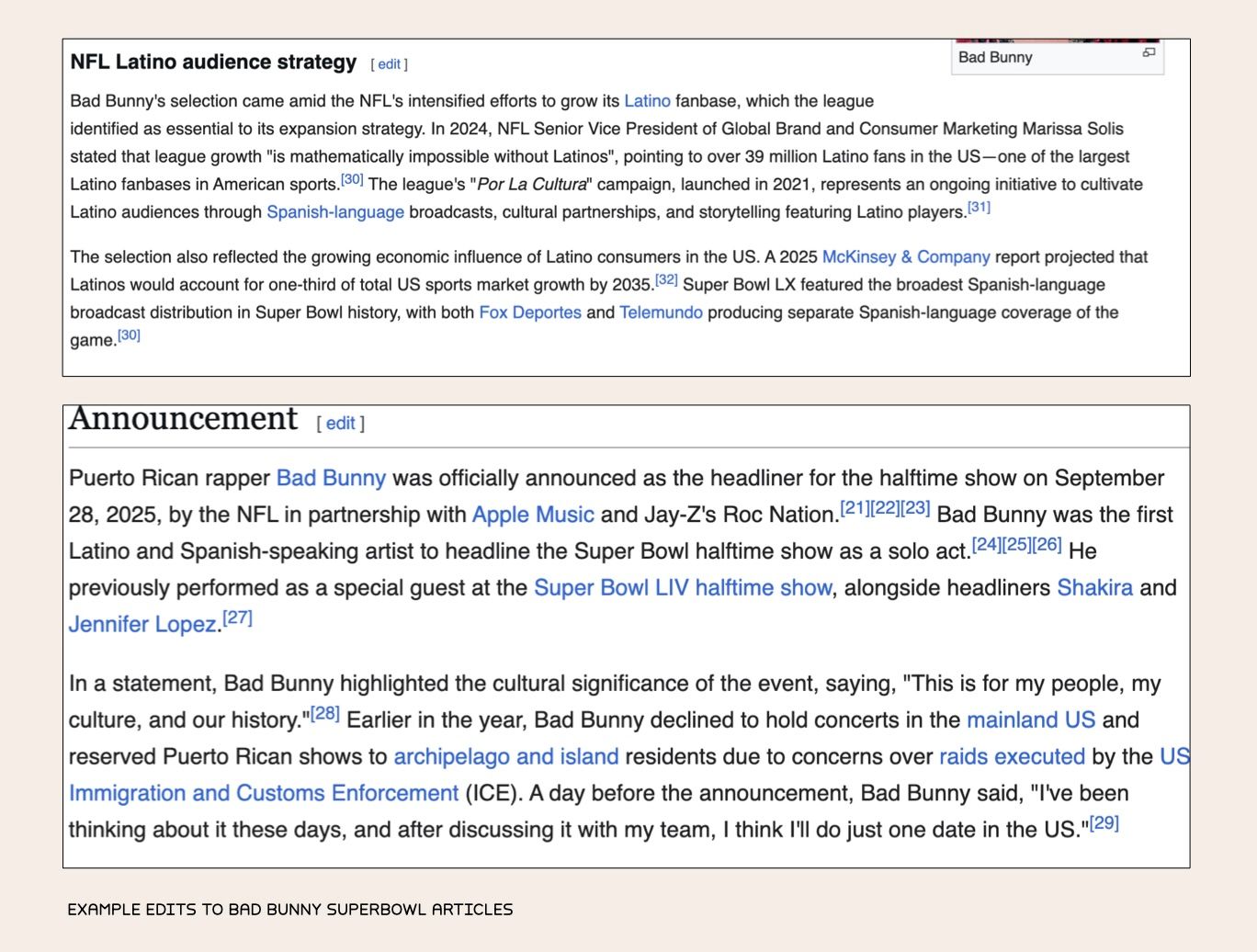
The results speak for themselves:
The research and recommendations from Harmony Labs inspired us to develop an even more proactive narrative strategy to ensure that when Wikipedia users search information about Latinos and issues important to them at key moments, they are reading information actually written by our community. Editing and contributing to Wikipedia is one of the most powerful ways to meet audiences where they are online. This work has allowed us to intervene at key cultural moments to create a deeper and more nuanced and factual account of the issues and topics important to us as a community. –Sam Gonzalez, VP, Culture at Maremoto
Based on this success, Maremoto repeated this approach for the 2026 World Cup, which resulted in 20 million+ views and mobilized more than 60 editors in both English and Spanish. And they anticipate continuing this kind of approach for other key events.
Identifying the cultural moments where your audience might engage allows you to plan ahead and capture their curiosity in the moment it matters most. By understanding the civic information landscape for Latinos through Harmony Labs media research, Maremoto is meeting audiences where they already are with accurate, properly contextualized information.
While the online information environment is shifting from search engine to AI-based information seeking, the strategies surfaced by this research and Maremoto’s own work with Wikipedia remain just as relevant. Instead of creating new web destinations, civic engagement strategy online can be successful by focusing on enhancing existing destinations that audiences already trust, like Wikipedia, with content that delivers the information they want, in the language they speak, while broadening their understanding of the civic context.
If you’re interested in finding your organization’s own source of capturable curiosity, get in touch.